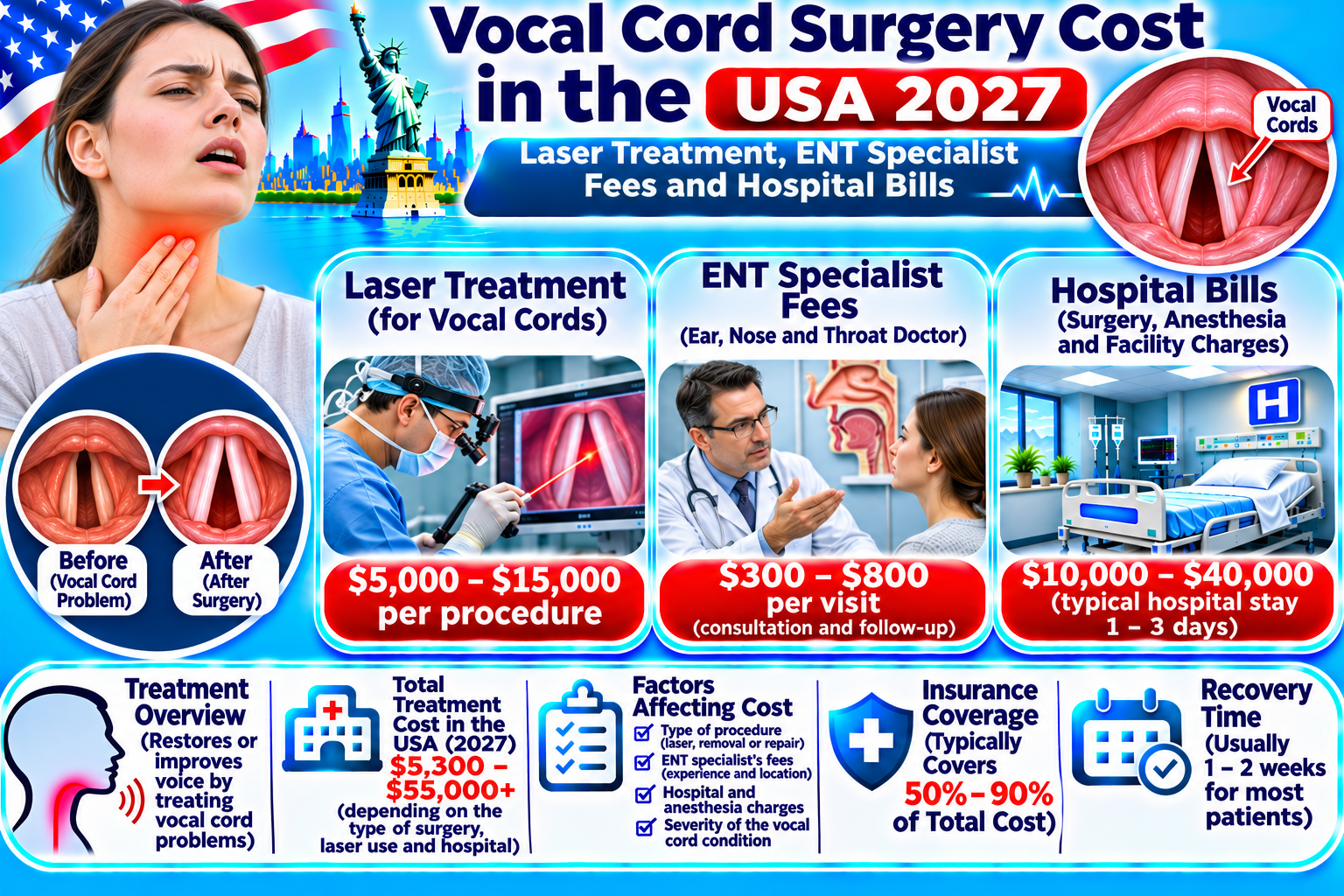
Vocal cord surgery is a specialized medical procedure used to treat certain conditions affecting the vocal folds, including benign growths, vocal cord paralysis, precancerous lesions, and selected cancers. The vocal cords are located inside the larynx, or voice box, and play an essential role in speaking, breathing, and protecting the airway during swallowing.
Understanding vocal cord surgery costs in the USA in 2027 is important for patients comparing laser treatment, microlaryngoscopy, vocal fold injections, ENT specialist fees, anesthesia charges, and hospital expenses. Treatment costs vary depending on the underlying condition, procedure complexity, surgical setting, and health insurance coverage.
Some voice disorders improve with speech-language therapy, medication, or lifestyle changes. Others require surgery to remove abnormal tissue, improve vocal fold closure, or address potentially serious disease.
This comprehensive guide explains estimated vocal cord surgery prices in the United States for 2027, including diagnostic examinations, laser procedures, hospital bills, Medicare coverage, recovery, and long-term voice care.
What Is Vocal Cord Surgery?
Vocal cord surgery refers to procedures performed on or around the vocal folds to improve voice function, breathing, swallowing protection, or treat abnormal tissue.
The vocal folds vibrate when air passes through them, producing sound. Changes in their structure, movement, or ability to close can cause hoarseness, weak voice, breathing difficulty, or swallowing problems.
An otolaryngologist, commonly called an ear, nose, and throat (ENT) specialist, evaluates these conditions. A laryngologist is an ENT physician with additional expertise in disorders of the voice box.
The appropriate treatment depends on the diagnosis. Surgery is not necessary for every vocal cord problem, and certain conditions are best managed initially without an operation.
Common Conditions Requiring Vocal Cord Surgery
Vocal Cord Polyps
Vocal cord polyps are usually benign growths that can develop after voice strain, irritation, or other contributing factors. Persistent polyps may require surgical removal when conservative treatment is insufficient.
Vocal Cord Nodules
Nodules are generally associated with repeated vocal stress. Voice therapy is usually the preferred initial treatment, while surgery is considered only in selected cases.
Vocal Fold Cysts
Cysts are lesions within the vocal fold tissue that may interfere with normal vibration. Some symptomatic cysts require microsurgical removal.
Vocal Cord Paralysis
Vocal fold paralysis occurs when one or both vocal folds cannot move normally. Depending on the cause and severity, treatment may involve injection augmentation, medialization surgery, or other specialized procedures.
Precancerous and Cancerous Lesions
Abnormal vocal fold tissue sometimes requires biopsy, laser excision, or other cancer-directed treatment. Early diagnosis is important because treatment choices depend on pathology and disease extent.
Symptoms of Vocal Cord Disorders
Voice disorders may produce a range of symptoms depending on the affected structures.
- Persistent hoarseness or rough voice.
- Weak or breathy speech.
- Voice fatigue during prolonged talking.
- Difficulty projecting the voice.
- Frequent throat clearing.
- Changes in vocal pitch.
- Discomfort while speaking.
- Coughing or choking during swallowing.
- Noisy breathing in certain airway conditions.
Persistent hoarseness should be evaluated by a qualified clinician, particularly when symptoms continue for several weeks or are accompanied by concerning features.
Severe breathing difficulty or rapidly worsening airway symptoms require immediate emergency care.
Causes and Risk Factors
Vocal cord problems may develop because of mechanical stress, inflammation, neurological conditions, or abnormal tissue growth.
Possible contributing factors include:
- Frequent shouting or excessive voice use.
- Smoking and exposure to irritating substances.
- Previous surgery involving the neck or chest.
- Neurological injury affecting vocal fold movement.
- Chronic inflammatory or respiratory conditions.
- Benign lesions or abnormal tissue growth.
- Age-related changes in vocal fold structure.
Not all hoarseness is caused by a surgical condition. A proper examination helps prevent unnecessary treatment.
How Are Vocal Cord Problems Diagnosed?
An ENT specialist typically begins with a medical history, voice assessment, and examination of the larynx.
Common diagnostic methods include:
- Flexible laryngoscopy to examine the vocal folds.
- Videostroboscopy to assess vocal fold vibration.
- Voice evaluation by a speech-language pathologist.
- Biopsy when suspicious tissue is present.
- CT or MRI when structural or neurological concerns require imaging.
- Swallowing assessment for selected patients.
Imaging is not routinely necessary for every patient with hoarseness. The examination findings guide further testing.
Types of Vocal Cord Surgery
Laser Vocal Cord Surgery
Laser surgery uses focused energy to remove or treat selected abnormal vocal fold tissue. Depending on the condition, the surgeon may use a laser through an operating microscope or an endoscopic system.
Laser treatment can be appropriate for certain benign lesions, precancerous changes, and selected early cancers.
The procedure requires careful technique because excessive tissue injury or scarring can affect voice quality.
Microlaryngoscopy
Microlaryngoscopy allows the surgeon to examine and treat the vocal folds using specialized instruments, usually while the patient is under general anesthesia.
It may be used to remove polyps, cysts, or suspicious tissue and obtain biopsy samples.
Vocal Fold Injection Augmentation
Injection augmentation involves placing material into a vocal fold to improve closure during speaking or swallowing.
It may be performed in an office or operating room, depending on the patient’s needs and the chosen technique.
Medialization Thyroplasty
Medialization thyroplasty places an implant through the framework of the larynx to improve vocal fold position.
This procedure may help selected patients with persistent vocal fold paralysis or weakness.
Reconstructive or Airway Surgery
More complex conditions may require additional laryngeal procedures to improve breathing, address scar tissue, or treat extensive disease.
These operations often involve greater surgical complexity and higher hospital expenses.
Vocal Cord Surgery Cost in the USA in 2027
American vocal cord surgery expenses depend on the diagnosis, surgical technique, anesthesia requirements, medical facility, and postoperative care.
Office-based procedures may involve lower facility expenses than operating room surgery, but the final cost depends on the treatment and provider.
The following figures are illustrative 2027 financial planning ranges rather than verified national averages, guaranteed quotations, or predictions of insurance reimbursement.
Estimated USA Cost Breakdown
| Treatment or Service | Estimated Cost (USD) |
|---|---|
| Initial ENT Specialist Consultation | $150–$500+ |
| Flexible Laryngoscopy | $250–$1,000+ |
| Videostroboscopy Examination | $300–$1,200+ |
| Office-Based Vocal Fold Injection | $1,000–$4,000+ |
| Microlaryngoscopy With Lesion Removal | $4,000–$12,000+ |
| Laser Vocal Cord Surgery | $5,000–$15,000+ |
| Operating Room Injection Procedure | $3,000–$9,000+ |
| Medialization Thyroplasty | $8,000–$25,000+ |
| Complex Laryngeal Surgery | $15,000–$50,000+ |
| Anesthesia Professional Fee | $500–$2,500+ if separately billed |
| Voice Therapy Session | $100–$300+ per session |
Important: These broad hypothetical ranges are intended only for preliminary budgeting. Surgical estimates may already include surgeon, facility, anesthesia, and pathology charges. Actual negotiated payments and patient out-of-pocket expenses may be substantially different.
USA Vocal Cord Treatment Cost Comparison
Because this article focuses on the United States, the following table compares American treatment scenarios rather than different countries.
| USA Treatment Scenario | Illustrative Overall Budget |
|---|---|
| Office-Based Injection Augmentation | $1,000–$4,000+ |
| Microlaryngoscopic Lesion Removal | $4,000–$12,000+ |
| Laser Vocal Cord Procedure | $5,000–$15,000+ |
| Medialization Thyroplasty | $8,000–$25,000+ |
| Complex Laryngeal Reconstruction | $15,000–$50,000+ |
These procedures treat different conditions and should not be considered interchangeable alternatives based on price alone.
Laser Vocal Cord Surgery Cost and Hospital Bills
Laser vocal cord surgery can be performed in different settings depending on the condition, the laser technology, and the patient’s medical needs.
Selected procedures may be performed in an ENT office using local anesthesia, while others require an operating room and general anesthesia.
The total cost may include laser equipment, physician services, endoscopic instruments, anesthesia, surgical supplies, and postoperative examinations.
Laser treatment is not automatically the best option for every lesion. Preserving healthy vocal fold tissue is essential for maintaining voice quality.
Microlaryngoscopy Surgery Expenses
Microlaryngoscopy is commonly performed as an outpatient procedure. The surgeon uses a microscope and delicate instruments to examine or remove abnormal vocal fold tissue.
Hospital charges may include operating room time, anesthesia, nursing services, pathology examination, and recovery monitoring.
Some patients return home on the same day, while individuals with complex medical conditions may need additional observation.
ENT Specialist and Laryngologist Fees
ENT consultation fees depend on the physician’s experience, appointment complexity, geographic location, and insurance contract.
Patients may require separate appointments for diagnostic laryngoscopy, voice assessment, surgery planning, and postoperative evaluation.
A specialist experienced in voice disorders can help determine whether surgery, voice therapy, or another treatment is most appropriate.
Laser Surgery vs Traditional Microsurgery
Both laser treatment and conventional microsurgical techniques can be effective for appropriately selected vocal fold lesions.
Office-based laser treatment may avoid certain operating room and anesthesia expenses. However, some lesions require precise microsurgical removal under general anesthesia.
A published randomized study comparing awake transnasal laser-assisted treatment with microlaryngeal surgery for benign laryngeal lesions reported lower hospital costs in the laser group.
Results from one study do not establish that laser treatment is always cheaper or medically preferable in every American healthcare setting.
Vocal Cord Surgery With Health Insurance
Many comprehensive American health insurance plans cover medically necessary vocal cord surgery when applicable requirements are satisfied.
Coverage may include ENT examinations, diagnostic laryngoscopy, surgical removal of lesions, treatment of vocal fold paralysis, and selected postoperative services.
Important insurance considerations include:
- Annual deductible and out-of-pocket maximum.
- ENT specialist and surgical facility network participation.
- Prior authorization for planned procedures.
- Coverage for laser surgery or microlaryngoscopy.
- Anesthesia and pathology benefits.
- Speech-language pathology and voice therapy coverage.
- Follow-up examinations and medications.
- Coverage for repeat procedures when necessary.
Insurance plans may distinguish medically necessary treatment from procedures performed primarily for elective or cosmetic voice changes.
Patients should request a personalized benefits estimate before planned treatment.
Medicare Coverage for Vocal Cord Surgery
Original Medicare generally covers medically necessary laryngeal procedures when applicable coverage requirements are met.
Medicare Part B commonly covers eligible outpatient physician services, diagnostic examinations, and qualifying surgical procedures.
For reference, Medicare’s 2026 procedure price lookup lists an average Medicare-approved amount of approximately $1,857 for direct operative laryngoscopy with biopsy in an ambulatory surgical center and approximately $3,970 in a hospital outpatient department.
The corresponding displayed patient shares are approximately $371 and $793 under the stated Original Medicare assumptions.
These figures relate to a specific laryngoscopy procedure, not every type of vocal cord surgery. Actual costs depend on procedure codes, location, additional services, deductibles, and supplemental coverage.
Medicare Advantage plans may have different authorization requirements, provider networks, and cost-sharing arrangements.
Medicaid and Financial Assistance
Medicaid may cover medically necessary vocal cord treatment for eligible individuals, depending on state-specific benefits and provider requirements.
Some nonprofit hospitals provide financial assistance for qualifying patients. Financial counselors can explain available payment programs.
Patients should confirm whether outpatient surgery, voice therapy, and postoperative appointments qualify for assistance.
Vocal Cord Surgery Without Insurance
Uninsured patients may face significant expenses for diagnostic testing, surgical procedures, anesthesia, and follow-up care.
Before accepting a planned treatment quotation, patients should ask:
- Does the estimate include the ENT surgeon’s fee?
- Are operating room and facility charges included?
- Will anesthesia be billed separately?
- Does the procedure require pathology testing?
- Are follow-up appointments included?
- Will voice therapy create additional expenses?
- What happens if another procedure is necessary?
Comparing complete written estimates can help patients avoid unexpected charges.
Factors Influencing Vocal Cord Surgery Prices
1. Type of Vocal Cord Disorder
A small benign lesion may require less extensive treatment than complex paralysis, recurrent papillomatosis, or cancer-related disease.
2. Surgical Technique
Office-based laser procedures, microlaryngoscopy, injection augmentation, and framework surgery involve different equipment and staffing requirements.
3. Hospital and Facility Charges
Operating room services, anesthesia, recovery monitoring, and specialized instruments contribute to total expenses.
4. Insurance Coverage
Deductibles, coinsurance, negotiated rates, and network restrictions can substantially change the amount patients pay.
5. Geographic Location
Healthcare prices vary across American cities and states because of regional operating costs and insurance arrangements.
6. Medications and Additional Services
Prescription medications, diagnostic imaging, pathology testing, and voice therapy may increase overall treatment costs.
7. Repeat Treatment Requirements
Certain vocal fold conditions can recur or require additional procedures. Repeat treatment may increase long-term medical spending.
Recovery After Vocal Cord Surgery
Recovery depends on the surgical technique, underlying condition, and amount of vocal fold tissue treated.
Some patients experience temporary hoarseness, throat discomfort, or voice fatigue after surgery.
The surgeon may recommend a period of voice rest followed by gradual return to speaking and structured voice therapy.
Patients should follow individualized instructions rather than assuming that complete voice silence is necessary after every procedure.
Voice Therapy After Surgery
Voice therapy is often an important component of treatment before or after vocal cord surgery.
A speech-language pathologist may teach techniques to reduce unnecessary vocal strain, improve breath support, and encourage efficient voice production.
The number of therapy sessions depends on the diagnosis, surgical outcome, and individual progress.
Insurance coverage for voice therapy varies, so patients should verify benefits before scheduling a treatment course.
Possible Complications and Additional Costs
Vocal cord surgery carries potential risks, including bleeding, infection, persistent hoarseness, vocal fold scarring, and incomplete improvement.
Some procedures also involve anesthesia-related risks or temporary swallowing difficulties.
Unexpected complications may require additional examinations, medications, therapy, or repeat surgery.
Patients should discuss expected benefits, limitations, and possible risks with their ENT specialist before treatment.
How to Reduce Vocal Cord Surgery Costs
- Verify insurance benefits before elective procedures.
- Request a complete written surgical estimate.
- Confirm ENT specialist and facility network participation.
- Ask whether anesthesia and pathology are included.
- Discuss whether office-based treatment is appropriate.
- Review voice therapy coverage.
- Explore hospital financial assistance programs.
- Follow postoperative instructions to support recovery.
The least expensive procedure is not necessarily the safest or most effective. Accurate diagnosis and preservation of voice function should remain priorities.
Frequently Asked Questions
How much does vocal cord surgery cost in the USA in 2027?
Illustrative costs may range from approximately $1,000 to $4,000 for selected office-based injections to $5,000 to $15,000 or more for laser vocal cord surgery. Complex procedures can cost substantially more.
Does insurance cover vocal cord surgery?
Many comprehensive plans cover medically necessary procedures, subject to policy requirements, authorization rules, and patient cost-sharing.
Is laser vocal cord surgery expensive?
Laser treatment costs depend on whether the procedure is performed in an office or operating room, the condition treated, and the required equipment.
Does Medicare cover microlaryngoscopy?
Medicare generally covers qualifying medically necessary laryngeal procedures under applicable outpatient or inpatient benefits.
How long does vocal cord surgery recovery take?
Recovery varies by procedure. Some patients return to routine activities relatively quickly, while voice improvement and rehabilitation may continue for several weeks or longer.
Can vocal cord problems return after surgery?
Yes. Certain lesions or voice disorders may recur, making follow-up examinations and appropriate voice care important.
Is voice therapy necessary after surgery?
Voice therapy is recommended for many patients, but the need and duration depend on the diagnosis and surgical outcome.
Conclusion
Vocal cord surgery costs in the USA in 2027 depend on laser treatment, microlaryngoscopy, vocal fold injections, ENT specialist fees, hospital expenses, and insurance coverage.
Patients should obtain detailed treatment estimates, verify insurance benefits, and consult an experienced ENT specialist or laryngologist to select an appropriate treatment plan.
Medical Disclaimer: This article provides general educational and financial planning information only. It does not replace professional medical advice, diagnosis, or treatment. All 2027 prices are illustrative estimates and should be verified directly with healthcare providers, hospitals, and insurance companies.
