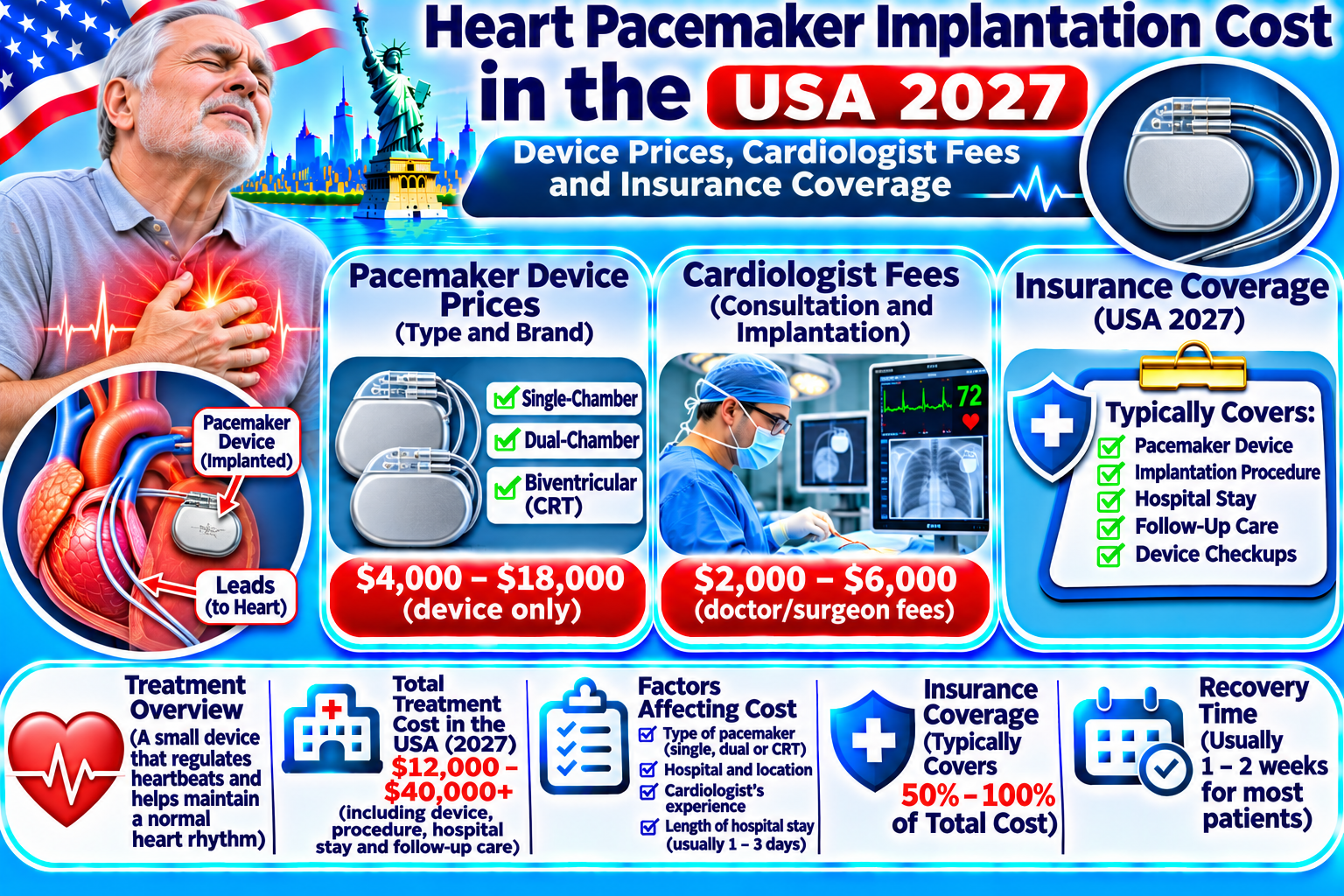
Heart pacemaker implantation is a common cardiac procedure used to treat certain abnormal heart rhythms, especially when the heart beats too slowly or electrical signals do not travel properly through the heart. A pacemaker helps maintain an appropriate heartbeat by delivering small electrical impulses when needed.
Understanding heart pacemaker implantation costs in the USA in 2027 is important for patients comparing device prices, cardiologist fees, hospital expenses, anesthesia charges, and health insurance coverage. The total cost depends on the pacemaker type, medical condition, implantation technique, healthcare facility, and insurance benefits.
Many pacemaker procedures are performed during a short hospital stay or outpatient encounter. However, patients with serious cardiac conditions or additional medical complications may require longer hospitalization and closer monitoring.
This comprehensive guide explains estimated pacemaker implantation expenses in the United States for 2027, including single-chamber devices, dual-chamber pacemakers, leadless technology, Medicare coverage, recovery, battery replacement, and long-term follow-up costs.
What Is a Heart Pacemaker?
A heart pacemaker is a small electronic medical device that helps regulate the heartbeat. Traditional pacemakers generally consist of a pulse generator containing a battery and electronic circuitry, along with one or more insulated wires called leads.
The pulse generator is commonly placed beneath the skin near the collarbone. Leads connect the device to the heart and allow it to detect electrical activity and deliver impulses when necessary.
Leadless pacemakers are smaller devices placed directly inside the heart through a catheter. They do not require a conventional chest generator or transvenous pacing leads.
Pacemakers do not cure every heart rhythm disorder. Their purpose is to manage specific electrical conduction problems and improve symptoms or safety in appropriately selected patients.
Why Might Someone Need a Pacemaker?
Doctors recommend permanent pacemakers when certain heart rhythm abnormalities cause symptoms or create clinically significant risks.
Common indications include:
- Symptomatic sinus node dysfunction.
- Certain forms of second-degree heart block.
- Complete or third-degree atrioventricular block.
- Persistent slow heart rhythms requiring treatment.
- Selected cases of atrial fibrillation with slow ventricular rates.
- Specific heart failure conditions requiring cardiac resynchronization therapy.
Not every slow heartbeat requires a pacemaker. Athletes and some healthy individuals naturally have lower resting heart rates without needing treatment.
A cardiologist evaluates symptoms, electrocardiogram findings, reversible causes, and overall cardiac function before recommending implantation.
Common Symptoms of Abnormally Slow Heart Rhythms
Patients with clinically significant bradycardia may experience symptoms related to reduced blood flow.
- Dizziness or lightheadedness.
- Unexplained fainting.
- Persistent fatigue or weakness.
- Reduced exercise tolerance.
- Shortness of breath during activity.
- Difficulty concentrating.
- Unusual awareness of a slow heartbeat.
Symptoms can vary depending on age, underlying heart disease, and the specific rhythm abnormality.
Fainting accompanied by chest pain, severe breathing difficulty, or persistent weakness requires urgent medical evaluation.
How Do Doctors Diagnose Pacemaker-Related Heart Conditions?
Before implantation, a cardiologist may recommend several examinations to understand the electrical problem and identify other cardiac conditions.
Common diagnostic tests include:
- Electrocardiogram to record heart rhythm.
- Holter monitoring for continuous rhythm assessment.
- Extended ambulatory cardiac monitoring.
- Echocardiography to evaluate heart structure and function.
- Blood tests to identify reversible causes.
- Electrophysiology evaluation in selected cases.
The required tests depend on the patient’s symptoms and medical history. Not every patient needs an extensive diagnostic workup.
Types of Heart Pacemakers
Single-Chamber Pacemaker
A single-chamber pacemaker usually delivers electrical impulses to one heart chamber, commonly the right ventricle or right atrium.
It may be appropriate for certain rhythm conditions, depending on the patient’s underlying cardiac electrical activity.
Dual-Chamber Pacemaker
A dual-chamber pacemaker generally uses leads positioned in the right atrium and right ventricle.
This configuration can help coordinate electrical timing between the two chambers in appropriately selected patients.
Leadless Pacemaker
A leadless pacemaker is implanted through a catheter, commonly introduced through a vein in the groin.
Because it does not require a conventional chest pocket or transvenous leads, it may reduce certain lead-related or pocket-related complications.
Leadless devices are not suitable for every patient, and available pacing capabilities differ between models.
Biventricular Pacemaker
A biventricular pacemaker, also called a cardiac resynchronization therapy pacemaker or CRT-P, coordinates stimulation of the ventricles in selected patients with heart failure and electrical conduction abnormalities.
CRT-P is more complex than a standard single-chamber pacemaker and may involve additional device and procedural expenses.
How Is Pacemaker Implantation Performed?
Traditional pacemaker implantation is usually performed in a cardiac catheterization laboratory, electrophysiology laboratory, or appropriately equipped operating room.
The physician commonly uses local anesthesia with sedation, although anesthesia plans vary.
For a transvenous pacemaker, the physician advances leads through a vein into the heart and connects them to the generator placed beneath the skin.
Device function is tested before the incision is closed. The medical team then monitors the patient for early complications.
Leadless pacemakers use a different catheter-based approach and do not require a conventional chest incision.
Heart Pacemaker Implantation Cost in the USA in 2027
American pacemaker implantation expenses depend on device selection, procedural complexity, hospital charges, specialist fees, and postoperative care.
Research on negotiated commercial insurance prices has demonstrated substantial differences in pacemaker facility fees and professional payments across insurers and hospitals.
The following amounts are illustrative 2027 planning ranges rather than verified national averages, guaranteed cash prices, or actual patient out-of-pocket costs.
Estimated USA Cost Breakdown
| Treatment or Service | Estimated Cost (USD) |
|---|---|
| Initial Cardiologist Consultation | $150–$500+ |
| Electrocardiogram | $50–$300+ |
| Echocardiogram | $300–$2,000+ |
| Holter or Ambulatory Monitoring | $150–$1,500+ |
| Single-Chamber Pacemaker Implantation | $15,000–$35,000+ |
| Dual-Chamber Pacemaker Implantation | $20,000–$45,000+ |
| Leadless Pacemaker Implantation | $25,000–$55,000+ |
| CRT-P Implantation | $30,000–$65,000+ |
| Pacemaker Generator Device | $3,000–$12,000+ as a cost component |
| Cardiologist Implantation Fee | $500–$3,000+ if separately billed |
| Anesthesia and Sedation Services | $500–$2,500+ if separately billed |
| Pacemaker Generator Replacement | $8,000–$25,000+ |
| Device Follow-Up Appointment | $100–$400+ |
Important: These hypothetical estimates represent broad possible billing ranges. Implantation episode prices may already include the device, hospital facility, physician, and anesthesia charges. Do not add individual components to a bundled estimate without checking for overlap.
USA Pacemaker Implantation Cost Comparison
Because this guide focuses on the United States, the following table compares pacemaker treatment scenarios within the American healthcare system rather than different countries.
| USA Treatment Scenario | Illustrative Overall Budget |
|---|---|
| Single-Chamber Pacemaker | $15,000–$35,000+ |
| Dual-Chamber Pacemaker | $20,000–$45,000+ |
| Leadless Pacemaker | $25,000–$55,000+ |
| Cardiac Resynchronization Pacemaker | $30,000–$65,000+ |
| Complex Implantation With Complications | $40,000–$100,000+ |
These devices are not interchangeable solely according to price. The correct pacemaker depends on the patient’s electrical conduction disorder, cardiac function, anatomy, and medical needs.
Pacemaker Device Prices and Technology Costs
The pacemaker device is an important component of the total implantation expense. Device pricing depends on the manufacturer, pacing capabilities, battery technology, and specialized features.
Traditional pacemakers may require one or more leads, while leadless devices combine the pacing system into a compact unit implanted directly inside the heart.
Advanced features, including remote monitoring, MRI compatibility under specified conditions, and sophisticated pacing algorithms, may influence device selection and pricing.
Hospitals frequently negotiate device purchasing contracts with manufacturers. The amount charged to a patient or insurer may differ considerably from the hospital’s acquisition cost.
Single-Chamber vs Dual-Chamber Pacemaker Costs
Single-chamber pacemakers generally involve fewer leads than dual-chamber systems. This may reduce equipment and implantation complexity in some cases.
Dual-chamber pacemakers can require additional lead placement, testing, and procedural time.
However, the lowest-cost device is not necessarily appropriate for a patient’s rhythm disorder. Device selection should be based on clinical requirements and expected long-term benefits.
Leadless Pacemaker Implantation Expenses
Leadless pacemakers are implanted using catheter-based technology, commonly through a vein in the groin.
The absence of a traditional chest pocket and transvenous leads may offer advantages for selected patients, particularly those with certain infection risks or vascular access concerns.
Leadless implantation can involve higher device and facility expenses than standard pacemaker implantation.
Patients should ask whether the hospital’s estimate includes the complete device, catheter equipment, imaging, and postoperative monitoring.
Cardiologist and Electrophysiologist Fees
Pacemaker implantation is commonly performed by a cardiac electrophysiologist, a cardiologist specializing in heart rhythm disorders.
Professional fees may include consultation, procedural planning, implantation, device testing, and postoperative evaluation.
Research published in 2026 found that median negotiated professional fees for permanent pacemaker insertion varied across major commercial insurers, ranging from approximately $344 to $885.
These figures represent specific negotiated professional payment comparisons, not the total price of surgery or a guaranteed amount charged to patients.
Hospital Charges and Implantation Facility Costs
Hospital expenses commonly represent a substantial portion of the total pacemaker implantation bill.
Charges may include:
- Cardiac catheterization or electrophysiology laboratory services.
- Pacemaker generator and pacing leads.
- Imaging and monitoring equipment.
- Nursing and technical staff.
- Medications and sterile supplies.
- Recovery room services.
- Overnight hospital accommodation when necessary.
Commercially negotiated facility prices vary significantly between hospitals and insurers. A 2026 study reported median facility fees for permanent pacemaker insertion ranging from approximately $6,366 to $17,678 across four major insurers.
These are negotiated facility prices, not comprehensive national patient bills.
2027 Medicare Pacemaker Reimbursement Examples
Published fiscal year 2027 Medicare inpatient payment information provides useful context for hospital reimbursement.
National inpatient payment examples for permanent cardiac pacemaker implantation include approximately $13,034 without qualifying complications or comorbidities, $15,575 with qualifying complications or comorbidities, and $23,080 with major complications or comorbidities.
These amounts are Medicare hospital payment benchmarks under specific classifications. They are not device retail prices, complete commercial hospital bills, or the patient’s personal financial responsibility.
Actual payments depend on hospital adjustments, coding, medical circumstances, and applicable Medicare rules.
Heart Pacemaker Implantation With Health Insurance
Many comprehensive American health insurance plans cover medically necessary pacemaker implantation when the patient meets applicable clinical requirements.
Coverage may include the pacemaker device, implantation procedure, hospital services, diagnostic testing, and follow-up evaluations.
Important insurance considerations include:
- Annual deductible and out-of-pocket maximum.
- Hospital and cardiologist network participation.
- Prior authorization requirements for planned implantation.
- Coverage for single-chamber and dual-chamber devices.
- Coverage criteria for leadless pacemakers.
- Hospital admission and outpatient facility benefits.
- Remote monitoring and device interrogation coverage.
- Coverage for future generator replacement.
Patients should request a personalized benefits estimate rather than assuming the advertised procedure price equals their out-of-pocket expense.
Medicare Coverage for Pacemaker Implantation
Original Medicare generally covers medically necessary permanent cardiac pacemakers when applicable national coverage requirements are satisfied.
Medicare Part A commonly applies to qualifying inpatient hospital admissions. Medicare Part B generally covers eligible outpatient procedures, physician services, and diagnostic examinations.
Leadless pacemakers have specific Medicare coverage and billing requirements that should be verified before planned implantation.
Medicare Advantage plans may have different provider networks, authorization rules, and cost-sharing arrangements.
Medicaid and Financial Assistance
Medicaid may cover medically necessary pacemaker implantation for eligible individuals, depending on state-specific coverage requirements.
Some nonprofit hospitals offer financial assistance programs for qualifying patients.
Hospital financial counselors can explain payment arrangements, insurance eligibility questions, and available assistance.
Pacemaker Implantation Without Insurance
Uninsured patients may face substantial expenses for the device, implantation procedure, specialist services, and hospital care.
Before accepting an elective treatment estimate, patients should ask:
- Is the pacemaker generator included?
- Are pacing leads and implantation supplies covered?
- Does the estimate include cardiologist fees?
- Will anesthesia or sedation be billed separately?
- Are hospital monitoring and overnight accommodation included?
- What follow-up appointments will be necessary?
- Does the hospital offer financial assistance?
Urgent cardiac symptoms should receive prompt medical attention. Financial comparisons must not delay emergency treatment.
Factors Influencing Pacemaker Implantation Prices
1. Pacemaker Type
Single-chamber, dual-chamber, leadless, and cardiac resynchronization devices involve different technologies and equipment costs.
2. Hospital and Facility Charges
Laboratory resources, staffing, equipment, and length of hospitalization influence the total bill.
3. Cardiologist Experience and Procedure Complexity
Complex anatomy, additional lead placement, and underlying cardiac conditions may increase procedural requirements.
4. Insurance Coverage
Deductibles, coinsurance, negotiated rates, and network participation affect personal expenses.
5. Geographic Location
Healthcare prices vary across American cities and states because of regional operating costs and insurance contracts.
6. Medications and Additional Testing
Blood tests, imaging, medications, and treatment of associated heart conditions can increase total spending.
7. Complications and Extended Hospitalization
Unexpected complications may require additional monitoring, imaging, procedures, or hospital days.
Recovery After Pacemaker Implantation
Recovery depends on the device type, implantation method, and patient’s overall health.
Many patients undergoing uncomplicated implantation return home after a short period of monitoring.
Temporary soreness, bruising, and discomfort near the incision are common after traditional implantation.
Patients should follow individualized instructions regarding wound care, arm movement, physical activity, driving, and return to work.
Possible Complications and Additional Expenses
Potential complications include bleeding, infection, lead displacement, pneumothorax, and device malfunction.
Some patients require repeat procedures, additional imaging, or hospital treatment.
Although serious complications are uncommon, they can substantially increase healthcare expenses and recovery time.
Pacemaker Battery Replacement Cost
Pacemaker batteries do not last indefinitely. Battery life varies depending on the device model, pacing requirements, and programmed settings.
Many conventional pacemakers function for several years before generator replacement becomes necessary.
Traditional generator replacement often involves replacing the pulse generator while retaining suitable existing leads.
Leadless pacemaker replacement strategies differ and depend on device technology and clinical circumstances.
Patients should include future device management and replacement costs in long-term financial planning.
Long-Term Pacemaker Monitoring Expenses
Pacemakers require periodic evaluation to confirm appropriate function, battery status, and pacing settings.
Follow-up may involve office-based device interrogation and remote monitoring.
Remote monitoring can help identify selected device problems without requiring an in-person visit for every routine check.
Patients should verify whether their insurance covers device monitoring services and related professional fees.
How to Reduce Pacemaker Implantation Costs
- Verify insurance benefits before planned implantation.
- Request a complete written hospital estimate.
- Confirm cardiologist and hospital network participation.
- Ask whether device and lead costs are included.
- Review Medicare or Medicaid eligibility where applicable.
- Explore hospital financial assistance programs.
- Confirm follow-up monitoring coverage.
- Discuss medically appropriate device options with the electrophysiologist.
The lowest advertised price is not necessarily the safest or most appropriate option. Device suitability, procedural quality, and long-term cardiac care remain essential.
Frequently Asked Questions
How much does pacemaker implantation cost in the USA in 2027?
Illustrative total billing estimates range from approximately $15,000 to $35,000 for a single-chamber pacemaker and $20,000 to $45,000 or more for a dual-chamber system. Actual costs vary by hospital and insurance.
Is a leadless pacemaker more expensive?
Leadless pacemakers may involve higher device and procedural expenses than traditional systems, although actual payments depend on the facility and insurance contract.
Does insurance cover pacemaker implantation?
Many comprehensive plans cover medically necessary pacemaker implantation, subject to policy requirements and patient cost-sharing.
Does Medicare pay for pacemakers?
Medicare generally covers qualifying medically necessary permanent cardiac pacemakers under applicable inpatient or outpatient benefits.
How long does a pacemaker last?
Pacemaker battery life varies by model and pacing needs. Regular device checks help doctors determine when replacement may become necessary.
Can patients live normally with a pacemaker?
Many patients resume routine activities after recovery. Individual restrictions depend on the underlying cardiac condition, device type, and physician recommendations.
Is pacemaker implantation major surgery?
Traditional pacemaker implantation is generally less invasive than open-heart surgery, but it remains an important medical procedure with potential risks.
Conclusion
Heart pacemaker implantation costs in the USA in 2027 depend on device technology, cardiologist fees, hospital expenses, procedural complexity, and insurance coverage.
Patients should compare complete treatment estimates, verify insurance benefits, and consult an experienced cardiologist or electrophysiologist before making treatment decisions.
Appropriate pacemaker selection and regular follow-up care can support long-term heart rhythm management and improve quality of life.
Medical Disclaimer: This article provides general educational and financial planning information only. It does not replace professional medical advice, diagnosis, or treatment. All 2027 cost ranges are illustrative estimates and should be verified directly with healthcare providers, hospitals, device suppliers, and insurance companies.
